Update
Please note that this is an old post that no longer reflects my views on the Swanston St separated bike lanes and protected bike lanes in general, if it ever truly did. (My comment on 30 Nov 2007 suggests that even when I wrote this post I knew I was being a bit contrary.)
Using a single anecdote to dismiss a whole approach to road design, as I did here, is pretty lame.
For a more mature discussion on the safety factors involved in separate bike lanes, see the Cycling Embassy of Great Britain's post Cycle paths are unsafe.
In travelling between the salt mine and the main sewer, I have the choice of riding either on Swanston St or Elizabeth St. Elizabeth is my usual choice; despite my previous moaning about the appalling bike lanes there, it's actually a pretty good run for a cyclist.
But yesterday, for some inexplicable reason, I turned the other way and headed for Swanston. Surely those fancy "Copenhagen" lanes would whiz me down the hill just as quickly? Uh-uh. Sad to say, it was not a pleasant experience.
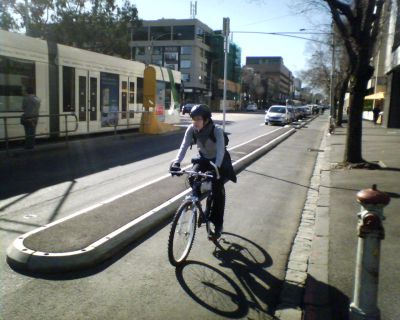
Here's the scenario: a Mr Speedy jumped the lights in front of me then promptly slowed to about half my cruising speed. Can I pass on the right? No. Slip through on the left? Forget it. These lanes are just too narrow for overtaking.
So I'm stuck in Mr Speedy's wake—but not too close, because I don't trust him. And a good thing too. Not much further on a pedestrian (yes, over there on the footpath) waves a car into a driveway, despite several bikes approaching on the downhill. The driver noses into the bike lane and Mr Speedy almost gets turned into a hood ornament. I brake heavily and avoid making a mess of it.
And then I hear a lot of rubber being laid-down behind me—another rider under heavy, heavy brakes. I'm boxed-in: bike and car in front, gutter on the left, raised pavement and parked car on the right…and rapidly decelerating rider behind. Likewise, Mr Deceleration has no options: he can't swerve because there's nowhere to go that wouldn't make things uglier.
Fortunately—amazingly—there were no collisions. But it could so easily have been a three-bike-plus-car pile-up. So very easily.
I didn't really like the Copenhagen-style lanes before but now they really f•cking scare me. They give you no real room to maneuver, which leaves you exposed to the inability and inattention of whoever happens to be riding nearby. When we ride on the open road, we don't have this safety restriction—it's almost always possible to swerve your way out of trouble. And it's easier to just give a potential problem a wider berth.
And I'm not the only one who is disturbed by the Copenhagen lanes: members of the BV Forums have discussed the issue several times. Most interestingly is an entry by Euan that points to a report from April this year: "Road safety and perceived risk of cycle facilities in Copenhagen" [no longer available on the authors' website]. It's worth reading the whole report (only nine pages) but this section jumped out at me:
…it can be deduced that the construction of cycle tracks has resulted in three important gains in road safety: fewer accidents in which cars hit or ran over cyclists from the rear, fewer accidents with cyclists turning left and fewer accidents in which cyclists rode into a parked car. These gains where more than outweighed by new safety problems: more accidents in which cyclists rode into other cyclists often when overtaking, more accidents with cars turning right, more accidents in which cars turning left drove into cyclists as well as more accidents between cyclists and pedestrians and exiting or entering bus passengers.
Sheesh. I think I'll avoid Swanston St from now on.
Update
On a later reading of that report, the following jumped out to me:
Taken in combination, the cycle tracks and lanes which have been constructed have had positive results as far as traffic volumes and feelings of security go. They have however, had negative effects on road safety. The radical effects on traffic volumes resulting from the construction of cycle tracks will undoubtedly result in gains in health from increased physical activity. These gains are much, much greater than the losses in health resulting from a slight decline in road safety.
[emphasis added]
While I have little need to travel along Swanston St these days, separated bike lanes would not seem to be a good reason to avoid riding that way.
Comments
I've never thought these lanes were a good idea, although you've given me a couple of extra reasons. I don't like them because every person exiting from a car has to cross directly in front of you. It's been a while since I rode Swanston street, maybe my criticism is irrelevant and there's no parking. Ignore me!
No, there's parking and that's part of the problem: bikes travelling in the bike lane are hidden from other vehicles by a line of parked cars.
I totally disagree that CBLs are too narrow to overtake. I think the issue is not the width of the CBL but a natural tendency-which I inhibit as well-to ride towards the middle i.e. hog the lane. This happens on all bike lanes, also on the painted-on ones as the ones on Elizabeth in the CBD. I do agree that on painted-on lanes you can just go around the slow biker who hogs the lane. On a CBL you are limited to ring your bell or indicate otherwise that you want to pass. The rider in front will respond and temporarily move closer to the left, giving you ample space to pass.
In a perfect world all cyclists would just automatically keep left so fast riders don't need to ring their bell all the time. We keep left on escalators, we should keep left on CBLs. Alternatively, we can 'help' people by having a dashed line as a divider and the occasional "keep left unless overtaking" message printed across the CBL.
I like CBLs because I am afraid that in an emergency my natural instinct will be to avoid and swerve to the right. On a CBL I will swerve into parked cars and a curb, and possibly get hit by other cyclists in a pile up. However, to me this is still preferable to swerving directly into traffic and get run over by a truck, bus or car.
By saying the following I may risk undermining my own arguments, but like you I ALWAYS take Elizabeth and have been since I first arrived here in 2003, before they had the painted-on bike lanes. In my view it is not only faster but much safer that Swanston because of...... the width. I have never understood Swanston street as a route for cyclist and consider it a death trap with the cars, taxis, trucks and trams. Talking about a lack of width, Swanston street is waaaaay too narrow. I'm talking about the CBD part now. I do like the CBLs on the Carlton stretch.
Thanks for the link to that PDF, we weren't aware of that and we'll investigate further. In the interests of balance, take a look at this video.
Given the volume of bikes on the lanes here at any one time, I'd say it's remarkably safe. Nice site by the way.
Overtaking isn't really the problem (although that report I quoted suggests that perhaps it is a problem), it's the lack of room to manoeuvre. The Swanston St lanes have been installed with curbs on both sides, which means that cyclists are strictly limited in the room available. (And let's not forget that the left-hand gutter is laid in bluestone and that there are also drain covers dotted along that edge of the lane, both of which reduce the effective width of the lane.)
It's this sense of being enclosed that I don't like and unlike Hielke I take no comfort from the idea of swerving into parked cars and a curb. Riding in the ordinary traffic lane gives you choice and control in an emergency situation—whether to swerve or hold the line depends on what's going on around you. In the Copenhagen-style lane, the choice is taken away.
Let me be clear here: I'm a utility cyclist and (although I've never experienced it first-hand) I think the Copenhagen bike culture is a good thing. But dumping Copenhagen 'solutions' onto Melbourne 'problems' without any real thought is not a formula for success.
The separated lanes as installed on Swanston St are wrong-headed and badly implemented. There was no need for them in the first place as there were functional and effective non-separated bike lanes there before (they just needed resurfacing).
I think the perception about the narrowness of the bike lanes and whether or not you can safely overtake is a relative thing. When I first moved to the Netherlands I was terrified by my work colleaugues insitence that we all ride three abreast in bicycle lanes that are far narrower than any you'll ever see in Australia. Our handlebars would be ever so slightly overlapping and we would maintain a sort of fluid ebb and flow rhythm as other cyclists ocassionally rang their bell to indicate they wanted to overtake. This is the norm there where cyclists, whole groups of them, maintain the same sorts of conversations that here would be normal between pedestrians on a pavement. The perception about what is a 'safe' width or space to cycle in is a learned one, very similar to the concept of what is normal 'personal space'. It took me a long time to be able to ride comfortably in this way but I have to admit, in five years of commuting daily to work on very narrow lanes, with over-lapping handlebars, gasbagging and smoking colleagues clutching an umbrella in one hand and pushy overtakers I was never once involved in or saw any sort of accident arising from this.
While many streets in Amsterdam don't have special lanes, there are some with Copenhagen style lanes. Just as with Swanston St these tended to be implemented on the busiest routes and I think cyclists learn to adapt their cycling to them. The other thing is that because there are so many more cyclists there they tend to be more aware and stay on the gutter side so that other cyclists can overtake. Cyclists here tend to rise in the centre of the bike lane, a luxury you don't have in busier cycling cities.
Yeah, I am prepared to accept that this may be largely a perceptual thing and that I and other road users just need time to adapt to the new conditions.
That's a really interesting detail about the riding habits of Amsterdamers. However, I think it'll be a long time before I'm comfortable enough with the ability of every random cyclist to ride in the way that faith described.
That said, I agree that if the segregated lanes have the effect that advocates predict—increased rider numbers—then riders will have to become more aware of the need to ride to the left and let others pass easily. Sheer weight of numbers will ensure that this happens.